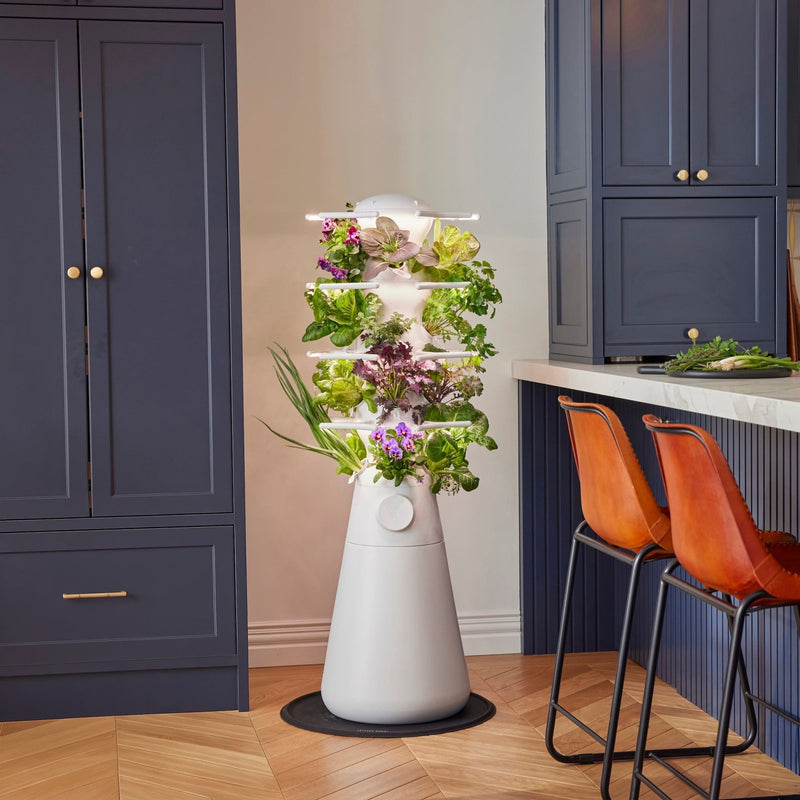
Whether it covers your household’s salads depends on your portions, usable growing space and replacement schedule. Do not translate a “20-pod” label into 20 salads a week. Start with a weekly target, then check the rotation and the actual weight you harvest.
Check your weekly lettuce rotation →First, define “enough salad”.
For a week, weigh the greens you normally use. Separate the leafy base from tomatoes, cucumber, dressing and toppings. That gives you a target in grams per week, rather than an ambiguous number of salads.
For example, two salads at a chosen 80g of greens each means 160g a week. That is a portion assumption for the calculation, not a recommended serving or a claim about what a pod produces. Seven bowls for two people at that same size would need 1,120g weekly.
Our first planner works in whole heads of lettuce, not grams or meals. To connect the two, weigh several of your own mature heads and use their average edible weight. Without that measurement, “a salad a day” is a goal, not a forecast.
How many lettuce plants do you need?
The important number is how many plants can reach your chosen harvest size at once. Reserve space for mature leaves and access for care, then subtract positions used for herbs or other crops. Nursery positions are additional space if seedlings grow outside the main unit.
Main-garden spaces needed = weekly starts × weeks occupying those spaces
For a target of two heads each week, an assumed 90% success rate gives three starts weekly. If each occupies the main garden for four weeks, you need 12 usable finishing positions. A two-week separate nursery needs another six seedling spaces. First harvest would be about six weeks after sowing under those assumptions.
The University of Tennessee’s small-scale hydroponics guide describes approximately six to eight weeks for many leafy crops under optimal conditions, including a transplant stage and a finishing stage. That supports planning overlapping batches; it does not establish the yield or timing of a branded countertop unit in your home.
What might a small setup supply?
This table uses our planner’s conservative whole-plant weekly batches: divide usable positions by finishing weeks, round down to whole weekly starts, then multiply by an assumed 90% success rate. The values are calculated scenarios, not measured harvests.
| Usable lettuce spaces | 4-week finishing stage | 6-week finishing stage |
|---|---|---|
| 6 | 0.9 heads/week | 0.9 heads/week |
| 12 | 2.7 heads/week | 1.8 heads/week |
| 20 | 4.5 heads/week | 2.7 heads/week |
A small setup can be useful without replacing all your salad purchases. A larger unit still needs enough light, suitable conditions and room for the plants you actually want to harvest. Compare countertop gardens and tower formats on their practical configuration, not just their maximum pod count.
A steady supply needs staggered planting.
Filling every space on one day creates plants of similar ages. Starting smaller batches at regular intervals spreads the replacement work and expected harvest dates. Here is the idea, rather than a prescription for a particular model:
Move A if ready
Harvest only when ready
Use your seed supplier’s instructions and observed growth to set transplant and harvest timing. If plants finish later, they occupy spaces longer and reduce the weekly capacity. Our planner makes that tradeoff visible and lets you download the schedule.
Build your weekly planting plan →Whole heads or a few leaves at a time?
These need different yield models. University of Minnesota Extension distinguishes repeated leaf harvesting from single head harvests. Taking usable outer leaves while leaving a plant growing can extend its use, but the amount picked each time must be recorded. How to harvest lettuce so it keeps growing covers both methods and which lettuce types regrow.
Do not count a whole head and then count all of its earlier leaf pickings again. If you prefer cut-and-come-again, log the edible grams from each picking and total them over several weeks. Our current planner does not estimate that harvesting method.
Will it save money?
Enough greens and cheaper greens are separate questions. Include hardware, lights, electricity, nutrients, replacement plants or seeds, delivery and any membership. Compare them with produce you would genuinely buy and eat. Exclude leaves you discard and avoid assigning a saving to every planting slot.
Use the ownership-cost calculator for the spending side. For your own running-cost-per-gram figure, divide the costs over a recorded growing period by the edible grams harvested in that same period. Decide separately how to spread hardware costs and whether to value your time.
What about “30 salads a month” claims?
Rise publishes a 30-salads-in-30-days planting routine using specified trays and repeated nursery batches. It is a manufacturer’s example, not a test conducted by us. Before applying any meal-count claim to your home, ask what portion weight, crop, tray configuration and growing conditions it assumes.
A practical first goal is one crop, one repeatable rotation and a harvest log. Once you know what your setup actually delivers, increase the target. The next useful question is not “How many pods fit?” but “How many usable greens reach my kitchen each week?”
Sources and method.
- University of Tennessee Extension, W 844-B, hosted by University of Kentucky: crop stages, capacity and staggered production. Its discussion is not a commercial indoor-system trial.
- University of Minnesota Extension: Small-scale hydroponics, for harvest methods.
- Rise Gardens planting routine, attributed manufacturer guidance.
Sources checked October 18, 2026. All table outputs are our arithmetic using explicitly stated example assumptions. We have not independently measured harvest weights for the systems in our directory. Manufacturer links here are ordinary source links.